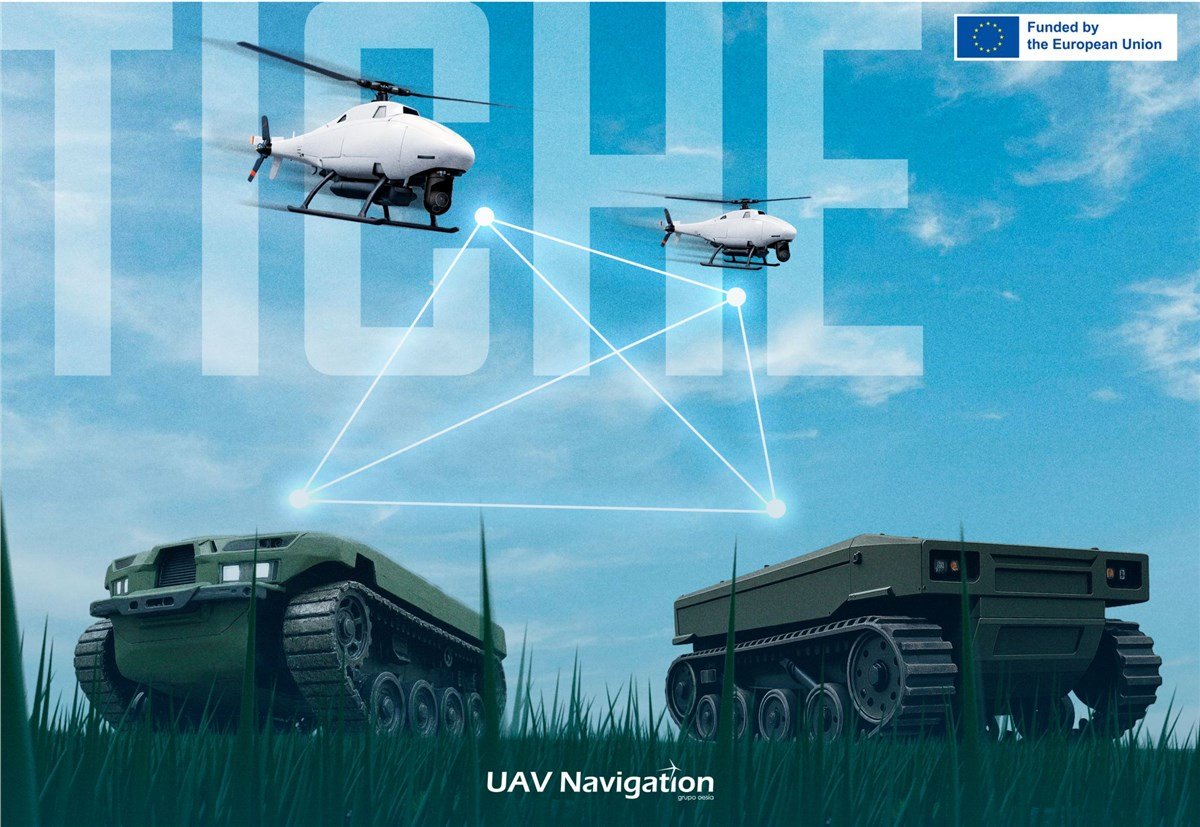
Landmines and IEDs do not discriminate between soldier and civilian. They remain hidden for decades, turning fields into death traps and roads into hazards. The TICHE Project, backed by the European Defence Funds, has embarked on a mission to change this reality, and UAV Navigation-Grupo Oesía is playing a pivotal role in the effort.
The primary objective of the TICHE initiative is deceptively simple but profoundly challenging: to detect hidden threats in complex environments without exposing humans to risk. To achieve this, the project is developing a sophisticated system that merges the “eyes in the sky” with the “hands on the ground.”
The concept relies on a collaborative fleet of unmanned ground vehicles (UGVs) and unmanned aerial systems (UAS). The drones act as rapid scouts, scanning terrain from above to identify anomalies, while the rovers move in to investigate using a suite of cutting-edge sensors. This teamwork allows for a layered defense against hidden explosives, ensuring that no single platform bears the full burden of detection.
The technological hurdle, however, lies in coordination. How do you ensure that a fast-moving aerial swarm communicates effectively with slow-moving ground robots in a chaotic environment? This is where UAV Navigation-Grupo Oesía’s decades of expertise come into play. As specialists in guidance, navigation, and control, they are engineering the “central nervous system” for the aerial fleet. Their role ensures that the UAS platforms can operate in tight, coordinated swarms while maintaining constant, reliable data links with their ground-based counterparts. This seamless integration is vital for the real-time data fusion that allows the system to distinguish between a harmless rock and a deadly IED.
The project is driven by a singular, powerful focus: the preservation of human life. Every algorithm written and every sensor calibrated is done with the intent of allowing military personnel and humanitarian teams to clear danger from a safe distance. The system is being designed with practical field use in mind, prioritizing portability and power efficiency so it can be deployed quickly and operate continuously during critical missions.
Led by RINA-CSM and funded by the European Union, the TICHE project is a powerful example of what happens when industry leaders unite for a common good. By pushing the boundaries of autonomous multiplatform operations, UAV Navigation-Grupo Oesía and its partners are not just advancing technology; they are building the tools needed to safeguard future generations.