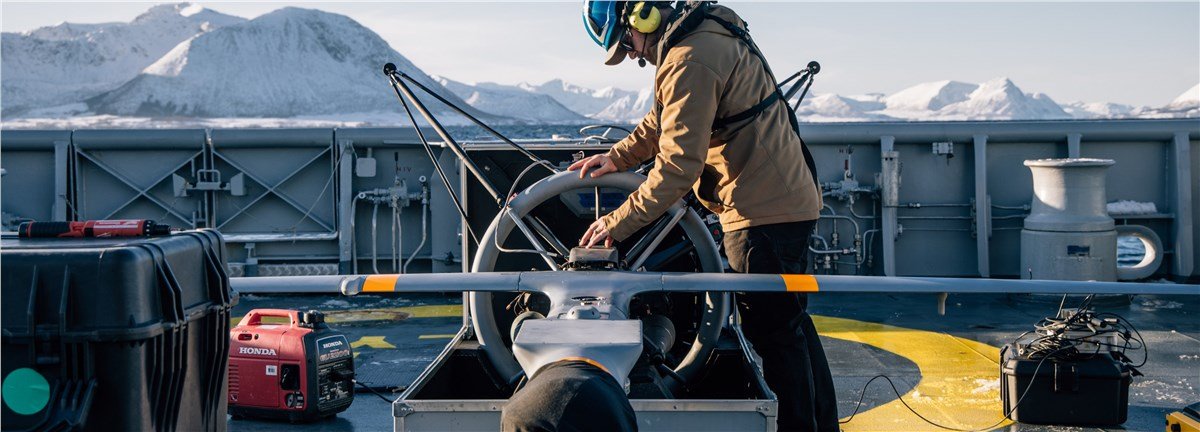
Shield AI has successfully demonstrated its V-BAT unmanned aircraft’s ability to perform intelligence, surveillance, and reconnaissance (ISR) missions in extreme cold weather during NATO’s HEIMDALL exercise in Norway. The event, hosted by the NATO Center of Excellence for Cold Weather Operations from February 17 to 26, served as a validation of the aircraft’s performance in Arctic maritime conditions without requiring any modifications.
The exercise focused on evaluating manned-unmanned teaming concepts and integrating ISR data into NATO’s Federated Mission Network and Multi-Domain Operations framework. V-BAT operated as an integrated ISR node within this architecture, completing multiple ship-based vertical takeoff and landing operations from the Norwegian Coast Guard vessel KV Olav Tryggvason, as well as land-based missions in Arctic winter conditions.
“We launched from land and from smaller vessels, operated in harsh weather, and conducted surveillance across both maritime and land domains,” said Brandon Tseng, Shield AI’s president and co-founder. “V-BAT serves as a force multiplier in contested maritime environments by giving commanders reliable ISR wherever they operate.”
The aircraft conducted both day and night operations using various sensor payloads, including electro-optic and infrared systems and synthetic aperture radar. Communications were maintained over multiple frequency bands between the V-BATs and forces at sea and ashore, with intelligence data fed directly into multinational command-and-control systems.
Chris Brinkley, senior director of business development for Europe and Africa, noted that cold weather operations present unique challenges for unmanned systems, including icing and extreme temperatures. “Being able to work with customers such as the Norwegian Coast Guard and the Norwegian Armed Forces, who really know and understand cold weather operations, meant we were able to gain the best feedback on our platforms.”
The V-BAT is a NATO Class I small VTOL unmanned aircraft featuring a ducted-fan design, more than 12 hours of endurance, and a heavy-fuel engine. Its enclosed-rotor design enables safe launch and recovery from ship decks and austere environments without launch or recovery equipment.
The successful demonstration highlights how users can deploy the V-BAT as an organic support asset anywhere globally, providing reliable ISR capabilities from the Caribbean to the high Arctic for maritime and amphibious missions.