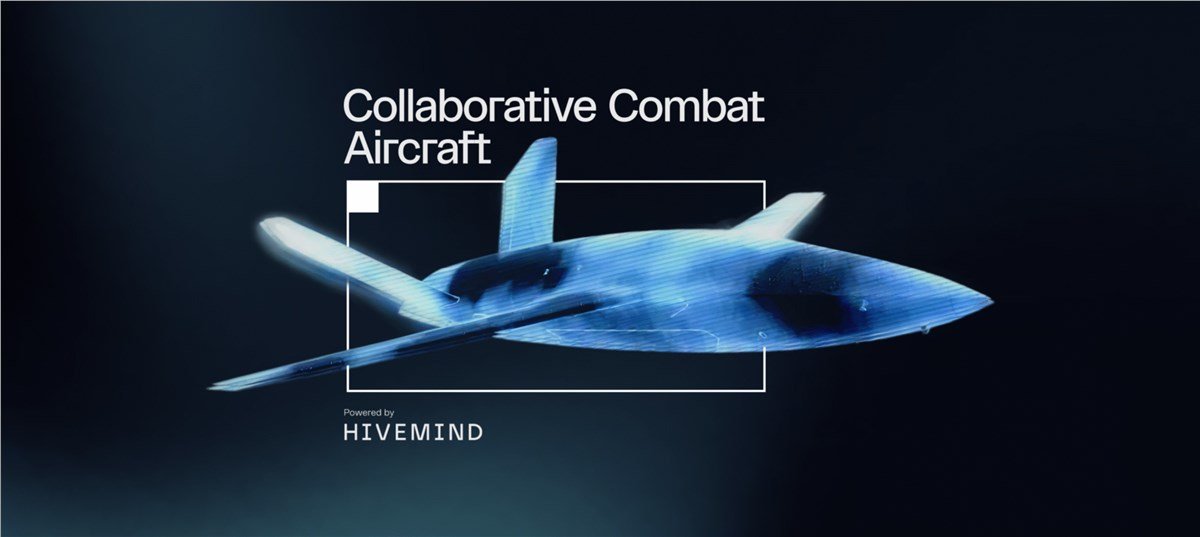
Shield AI, a specialist in autonomous flight software and unmanned aircraft systems, has been selected by the U.S. Air Force to contribute to the Collaborative Combat Aircraft (CCA) program. The company will focus on mission autonomy development as part of the Technology Maturity and Risk Reduction (TMRR) phase following a competitive evaluation process.
The CCA program represents a significant shift in how the Air Force envisions future air combat operations. Rather than replacing manned aircraft, these autonomous collaborative platforms are designed to operate alongside them as force multipliers. The initiative aims to field uncrewed aircraft capable of executing complex missions while remaining under human supervision.
Central to Shield AI’s involvement is its Hivemind autonomy software, which has already been integrated onto Anduril’s Fury aircraft, designated YFQ-44A. The integrated system is currently undergoing testing in preparation for flight demonstrations scheduled in the coming months. Hivemind differs from conventional autopilot systems by functioning as an artificial intelligence pilot, enabling aircraft to sense their environment, make tactical decisions, and execute missions without direct human control.
Rather than following preprogrammed routes, Hivemind-equipped aircraft can dynamically respond to changing battlefield conditions. The software allows platforms to navigate around restricted airspace, identify and respond to threats, and adapt to unexpected scenarios while maintaining mission effectiveness.
Gary Steele, CEO of Shield AI, noted the company’s long-term focus on practical autonomy development. “The Air Force is moving with urgency to explore how autonomy can reshape air combat, and we have spent years preparing for this—building, testing, and flying mission autonomy in the real world,” Steele said.
Christian Gutierrez, vice president of Hivemind Solutions, emphasized the operational experience behind the technology. According to Gutierrez, the company brings proven expertise in fielding mission-critical autonomous systems on complex weapon platforms, combined with deep operational understanding across multiple domains.
The Hivemind software complies with the Autonomy Government Reference Architecture (A-GRA), ensuring compatibility with broader government technology standards. The platform-agnostic system has previously demonstrated A-GRA-aligned autonomy across various test efforts, including work with General Atomics’ MQ-20 Avenger, Northrop Grumman’s Talon IQ autonomous ecosystem, U.S. Navy BQM-177 test aircraft, and the Airbus UH-72A Lakota helicopter.
The selection positions Shield AI among key industry partners helping define how autonomous systems will integrate into future Air Force operations. The CCA program represents a cornerstone of the service’s broader vision for manned-unmanned teaming, where autonomous aircraft extend the capabilities of traditional fighter fleets.