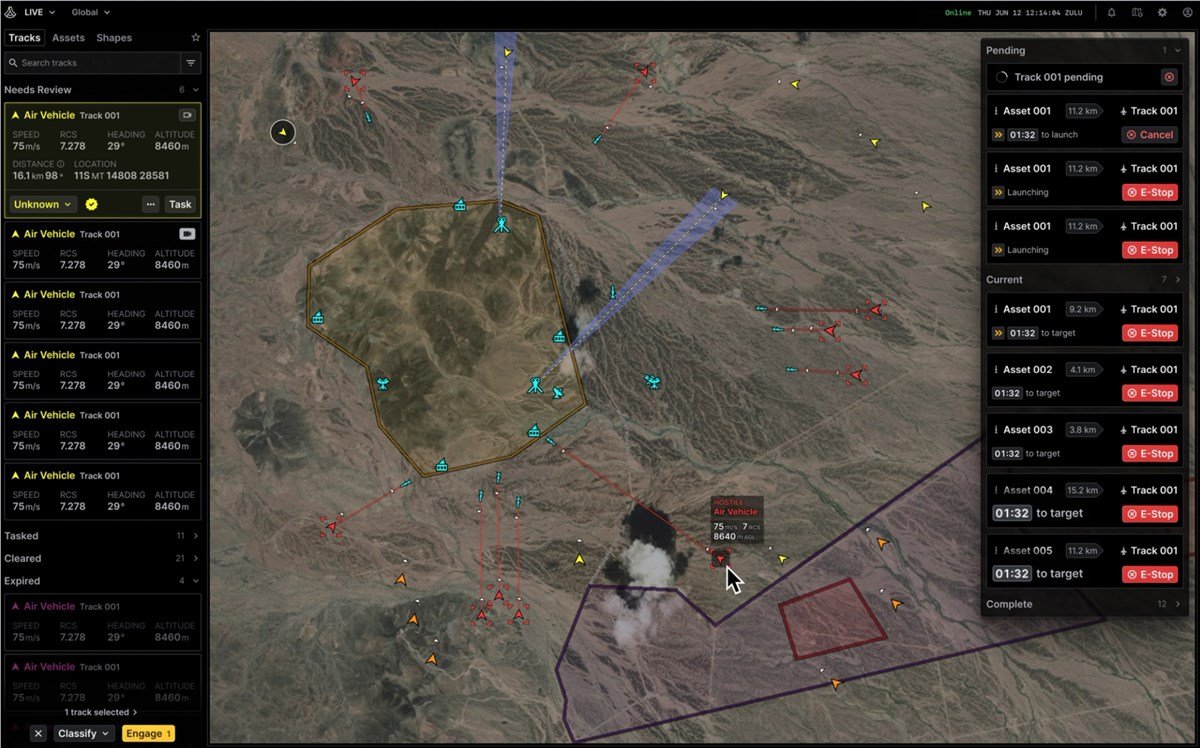
The U.S. Army has selected Anduril Industries to provide the core command-and-control platform for its next-generation air defense, aiming to solve a critical modern vulnerability: drone swarms. The contract for the Integrated Battle Command System-Maneuver (IBCS-M) program establishes Anduril’s Lattice software as the Army’s essential “brain” for counter-unmanned aircraft system (C-UAS) missions.
This move is a direct response to a transformed threat. Modern battlefields are saturated by small, cheap drones that can attack in overwhelming numbers, operating faster than traditional human-involved decision loops. Legacy command systems, designed for predictable, slower-moving threats like missiles or aircraft, cannot process data or execute engagements at the required speed.
IBCS-M is designed to be the adaptable backbone that unifies this chaotic fight. It will fuse data from a wide array of disparate sensors—whether legacy radars or new, undisclosed technologies—and seamlessly integrate various “effectors” or weapons. The goal is to enable a single operator to manage multiple, simultaneous threats by automating key steps in the targeting process, dramatically compressing the time from detecting a drone to defeating it.
Anduril recently demonstrated this capability at Yuma Proving Ground. In a seven-day trial, the Lattice-based system integrated a new, unspecified sensor and weapon within hours—not months or years—and successfully executed four live-fire intercepts against drone targets. The demonstration also featured advanced autonomy for fire control and distributed tracking, proving the system’s ability to learn and adapt rapidly in a tactical environment.
“We can’t think of counter-UAS as static… It has to be software-centric and adaptable above all else,” said Alex Miller, CTO of the U.S. Army. He emphasized that soldiers need systems that can evolve immediately in the field, supporting a platoon on the move as effectively as a fixed base.
The IBCS-M award represents a significant shift in Pentagon procurement philosophy, favoring a faster, software-driven approach over traditional, decade-long hardware programs. For Anduril, a defense technology company founded in 2017, it marks a major validation of its core thesis: that modern defense requires open, AI-powered software architectures that can integrate new technology at the speed of relevance.
“Our work in autonomous systems and command and control has built the foundation for this moment,” said Matt Steckman, President and Chief Business Officer of Anduril Industries. The program aims to create a unified ecosystem where data flows into decisive action, ensuring U.S. forces can outpace autonomous threats.